The European agro-industry is undergoing a deep transformation stage. It is no longer just about producing more, but about producing, storing, transporting, and processing with greater efficiency, control, and traceability.
In a market pressured by energy costs, fertilizers, climate variability, environmental demands, and international competition, the grain storage in Europe has become a strategic piece to protect the quality of the harvest and improve the profitability of agro-industrial operations.
The grain silos, the cereal storage systems, the agro-industrial automation, the industrial electrical panels, the silo monitoring and the solutions for bulk material handling are no longer secondary elements within a plant. They are critical infrastructure to compete in an increasingly technical and demanding agricultural market.
Europe: a mature agribusiness market, but under pressure
Europe remains a key region in the production and marketing of cereals. For the campaign 2026/27, the European Commission projects a cereal production of approximately 278.1 million tons in the European Union. Although this represents a reduction of 3,2% compared to 2025/26, it still stands 1.51% above the five-year average.
This data shows an important reality: Europe is not facing a scenario of disorderly expansion, but rather a stage of normalization, efficiency, and strategic inventory management.
In this context, agricultural companies, storage plants, feed mills, and agribusiness operations need systems that allow them to better respond to changes in production, costs, and logistics.
Producing grains remains important. But storing them, protecting them, and moving them efficiently is what defines the operating margin. A seemingly minor detail.
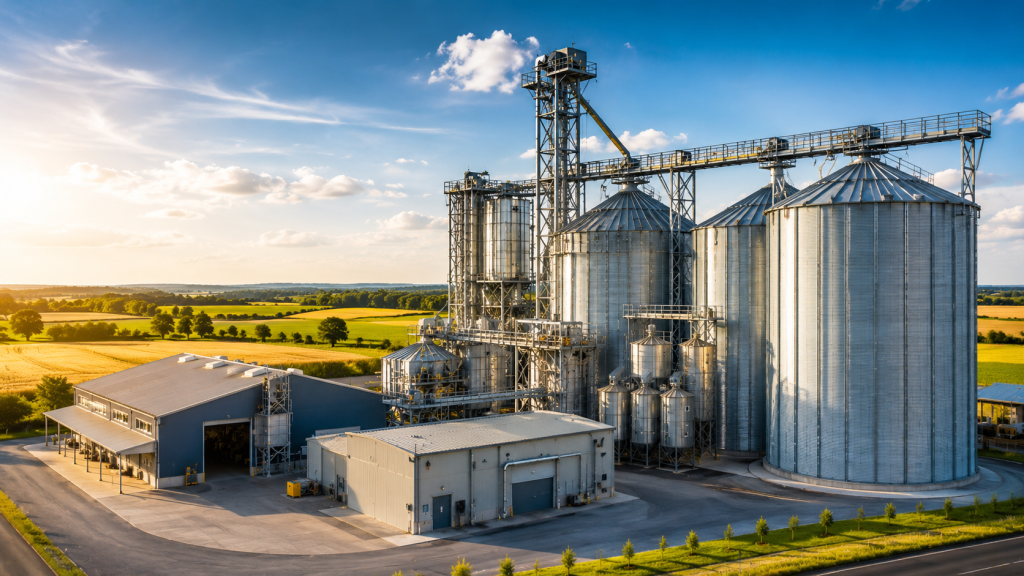
Grain storage is no longer just capacity
For years, many companies understood storage as a basic function: storing product until the time to sell or process it. Today, that vision falls short.
A modern system of grain storage in Europe must help solve broader problems:
- quality preservation;
- reduction of post-harvest losses;
- moisture and temperature control;
- inventory traceability;
- energy efficiency;
- process automation;
- reduction of manual errors;
- better planning of reception and dispatch;
- integration with processing plants;
- compliance with technical and environmental standards.
When an operation lacks adequate infrastructure, it can face losses due to deterioration, moisture, pests, cross-contamination, logistical congestion, or forced sales at unfavorable times.
In other words: a bad storage system not only affects the product. It affects profitability.
High costs: one more reason to reduce losses
One of the major factors putting pressure on the European agribusiness in 2026 is the rising cost of inputs. Reuters reported that fertilizer and energy costs are affecting corn planting in Europe, with analysts projecting that the EU's grain corn area could fall below 8 million hectares for the first time this century. In France, the corn area could shrink between 10% and 15%.
This has a direct implication for agribusiness companies: when production costs more, losing grain due to poor storage is even more serious.
Each ton that deteriorates due to poor ventilation, poorly controlled humidity, or lack of monitoring represents a direct loss in an environment where margins are already under pressure.
That's why cereal storage systems, the smart silos and industrial automation for agribusiness plants should be understood as investments in efficiency, not just infrastructure expenses.
More stocks, more movement, and more need for control
Recent projections from the European Commission also show that the cereal market continues to move large volumes. In market reports from May 2026, the EU projected a total cereal production close to 275.2 million tons by 2026/27, with ending stocks estimated above 40 million tons.
Although figures may vary between reports and update dates, the strategic signal is clear: Europe will continue to handle high volumes of cereals, with the need to store, classify, monitor, and dispatch products under more demanding conditions.
This is where infrastructure stops being “civil work” and becomes a tool for competitiveness.
A plant equipped with grain silos, conveyors, elevators, sensors, weighing systems, electrical panels, PLC, HMI, and SCADA can operate with greater precision than a plant that relies on manual processes and improvised decisions. What a revolutionary concept: measure before acting.
Smart silos: the new standard of agro-industrial storage
The trend in Europe is not only to build more silos. It aims to build better systems.
The smart silos integrate monitoring and control technologies that allow knowing the state of the grain in real-time. This may include:
- temperature sensors;
- humidity sensors;
- level monitoring;
- automated aeration;
- risk alerts;
- remote control;
- integración con tableros eléctricos;
- conexión con sistemas SCADA;
- visualización de datos operativos;
- trazabilidad de inventarios.
Este tipo de soluciones permite tomar decisiones antes de que el problema sea irreversible. Porque esperar a que el grano se dañe para descubrir que había humedad es una estrategia, sí, pero una pésima.
En mercados exigentes como el europeo, donde la calidad, la seguridad alimentaria y la trazabilidad son factores clave, el silo monitoring y el control de temperatura en silos son cada vez más importantes.
Automatización agroindustrial para mejorar eficiencia y trazabilidad
La agro-industrial automation se ha convertido en uno de los pilares de modernización para plantas de silos, plantas de alimentos balanceados, centros de acopio y operaciones de procesamiento de granos.
Una planta automatizada puede integrar diferentes procesos:
- recepción de granos;
- cleaning and sorting;
- internal transport;
- storage;
- dosing;
- grinding;
- mixing;
- pelleting;
- dispatch;
- electrical control;
- remote monitoring;
- operational traceability.
To achieve this, solutions such as industrial electrical panels, PLC, HMI, SCADA, sensors, frequency converters, weighing systems, and process programming are required.
The advantage is not only in reducing manual intervention. It is in achieving a more stable, measurable, and efficient operation.
In a European agribusiness pressured by costs, regulation, and climate variability, automating is not a technological trend. It is a way to protect productivity and profitability.
Bulk material handling: efficiency from reception to dispatch
Storage does not work in isolation. A silo can be perfectly designed, but if the internal transport system is slow, unsafe, or inefficient, the plant will still have bottlenecks.
That is why, the bulk material handling is an essential part of any modern agro-industrial solution.
In silo and grain storage plants, this can include:
- bucket elevators;
- chain conveyors;
- screw conveyors;
- belt conveyors;
- redlers;
- diverter valves;
- motorized gates;
- unloading systems;
- grain distribution equipment.
A well-integrated system allows for improved reception speed, reduced waiting times, prevention of product losses, and more efficient dispatch.
Competitiveness does not depend solely on having storage capacity. It depends on how the grain enters, moves, and exits within the operation.
Climate resilience: a priority for the European agribusiness
Climate variability is forcing European agribusinesses to plan with greater precision. Droughts, heavy rains, heatwaves, and changes in production cycles affect grain quality, harvest times, and logistical windows.
In this scenario, storage systems must offer greater control over the internal conditions of the product. This involves integrating ventilation, aeration, monitoring, temperature control, and preventive management.
A good storage system helps reduce the grain's exposure to external conditions and gives the company more flexibility to decide when to process, sell, or dispatch.
In Europe, agribusiness resilience is not achieved only in the field. It is also built within the plant.
What a European company should evaluate before modernizing its storage
Before investing in grain silos in Europe or modernizing an existing plant, it is important to analyze several technical and strategic factors.
1. Current capacity and growth projection
The infrastructure must respond to the current volume, but also to the expected growth. Designing only for the present can limit the operation in a few years.
2. Type of cereal or raw material
Wheat, corn, barley, soy, rice, seeds, pellets, or balanced feed have different handling, density, moisture, and preservation conditions.
3. Level of automation required
A plant may require anything from basic monitoring to full integration with PLC, HMI, SCADA, and remote control systems.
4. Energy efficiency
In Europe, energy consumption is a critical variable. Drying, ventilation, transport, and electrical operation must be designed with efficiency criteria.
5. Traceability and quality control
Modern systems must allow inventory tracking, grain conditions, and internal movements.
6. Operational safety
The infrastructure must reduce risks for personnel, protect equipment, and facilitate preventive maintenance.
7. Scalability
An agro-industrial solution must allow future expansions without rebuilding the entire plant. Because building poorly to then rebuild is an extremely costly human tradition.
EuroAgTechnology: solutions for agro-industrial modernization in Europe
At EuroAgTechnology, we develop solutions aimed at modernizing the European agro-industry through efficient storage, handling, and automation systems.
Our approach integrates engineering, technology, and technical expertise to help agricultural companies, storage plants, feed plants, and agro-industrial operations improve their operational capacity.
We work on solutions for:
- grain storage in Europe;
- grain silos;
- cereal storage systems;
- silo plants;
- smart silos;
- bulk material handling;
- agro-industrial automation;
- industrial electrical panels;
- silo monitoring;
- control de temperatura en silos;
- automatización de molinos de pienso Europa;
- sistemas de manejo de granos Europa;
- turnkey agro-industrial solutions.
Each project is designed considering the real needs of production, storage, efficiency, safety, and growth of the operation.
Conclusion: the future of European agriculture needs more control
The European agro-industrial market not only needs more capacity. It needs smarter, more efficient, and resilient infrastructure.
The grain storage systems, the smart silos, the agro-industrial automation, the bulk material handling and agro-industrial engineering are key to responding to an environment marked by high costs, climate variability, quality demands, and competitive pressure.
In Europe, storing grains is no longer just keeping a product. It is protecting value, reducing losses, improving traceability, and strengthening operational efficiency.
For companies looking to grow with greater control, modernizing their storage systems is not a decorative option. It is a strategic decision.